
Concrete Patio Contractor in Springfield, IL
A patio in Springfield sits on ground that holds water and under a sky that freezes and thaws all winter. Getting one to stay flat and unspalled for twenty years is mostly about what happens before the concrete arrives.
Why Springfield Patios Move
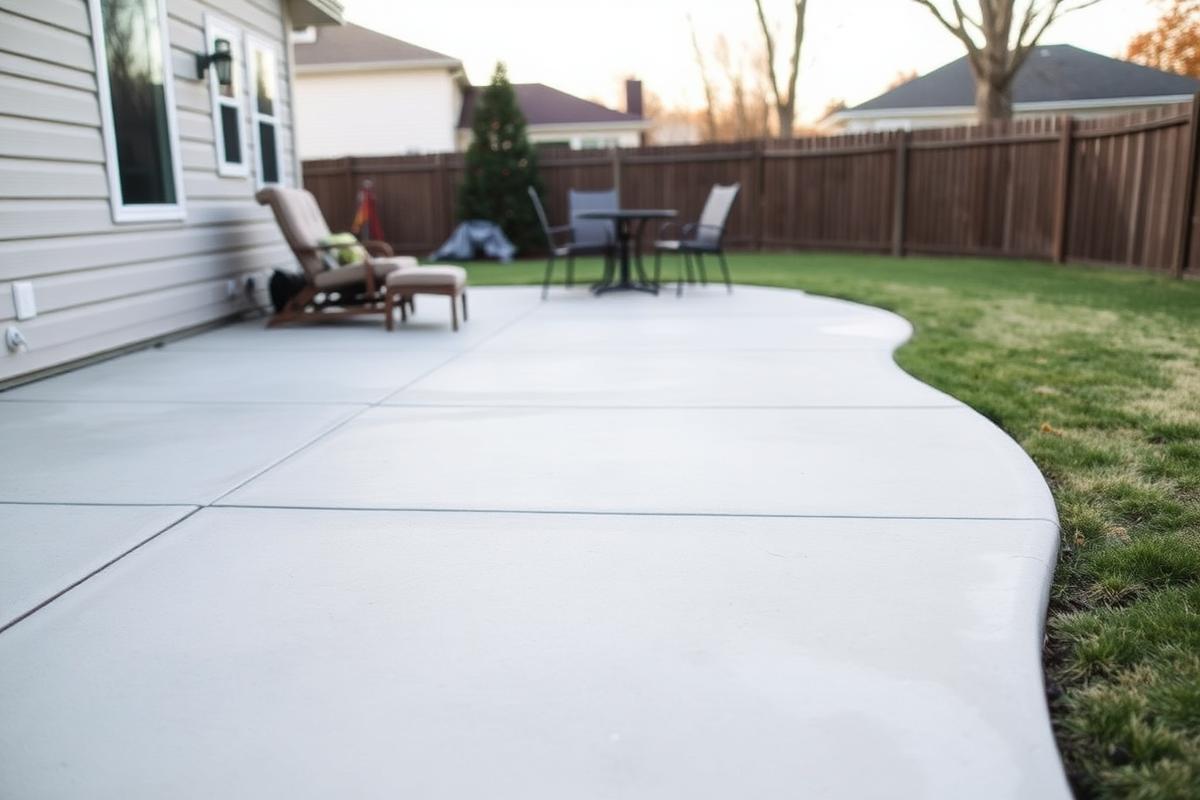
The silt loams mapped across Sangamon County formed in loess and carry a smectitic clay fraction — the kind that expands with moisture and contracts as it dries. Under a patio sitting directly against the back of a house, that movement concentrates exactly where you least want it: at the door threshold. Slopes across most of the area are gentle enough that water does not run off on its own, so a patio has to be pitched deliberately away from the foundation, typically a modest but consistent fall across its width. Anything less and the low corner becomes the spot that heaves first.
Pitch Away From the House
A small, consistent slope moves roof and surface runoff away from foundation backfill.
Compacted Stone Base
Buffers the slab from a subgrade that changes volume seasonally and gives water a route out.
Isolation at the House
Separating the patio from the foundation lets the two move independently instead of fighting.
Freeze-Thaw and Finish Choice
Roughly 36 inches of annual precipitation and repeated winter freeze cycles put central Illinois patios under real stress. Air-entrained mix is the baseline. Beyond that, the finish matters more than most homeowners expect: a hard-troweled, glassy surface looks good in October and scales in March, while a light broom finish sheds water, gives grip in ice, and holds up. Stamped and colored work is entirely doable here, but it wants a sealer refreshed every few years, because the sealer is doing part of the freeze-thaw defense.
Broom Finish
The most durable and slip-resistant option through Illinois winters.
Stamped and Colored
Attractive and viable locally, with a real maintenance commitment attached.
Exposed Aggregate
Good traction and hides wear, though it collects debris under a tree canopy.
Backyard Realities Around Town
Access decides more about a patio job than the design does.
Older West Side and Enos Park Lots
Deep, narrow yards with fences and tight side gates; concrete often has to be wheeled or pumped rather than chuted.
Leland Grove Tree Cover
Established roots limit excavation depth and heavy shade slows curing and keeps a patio damp and mossy.
Chatham and Sherman Newer Builds
Open rear access is a real cost advantage, but young grades on former farmland may still be settling.
Rochester and Riverton
Lower-lying lots near the Sangamon put drainage design ahead of aesthetics.
Sizing and Planning the Space
Before dimensions, it helps to know what actually happens out there. A table with chairs pulled out needs meaningfully more depth than people assume; a grill area needs clearance from siding; a hot tub is a structural question, not a patio question. Tell us the furniture and the traffic pattern, then let the dimensions follow. If the patio connects to an existing walk, stoop, or driveway, those meeting points and their elevations are worth photographing — mismatched elevations are the most common thing that turns a straightforward patio into a grading project.
Request Your Patios Estimate
Call Springfield IL Concrete or submit the estimate form to discuss your project.
Request a Concrete Estimate in Springfield
Call Springfield IL Concrete or submit the estimate form with your project details.