
Concrete Driveway Installation in Springfield, IL
A driveway in Springfield has to survive smectitic silt loam underneath it and roughly four months of freeze-thaw on top of it. Those two facts shape almost every choice we make on a driveway job — base depth, mix, joint spacing, and where the water goes.
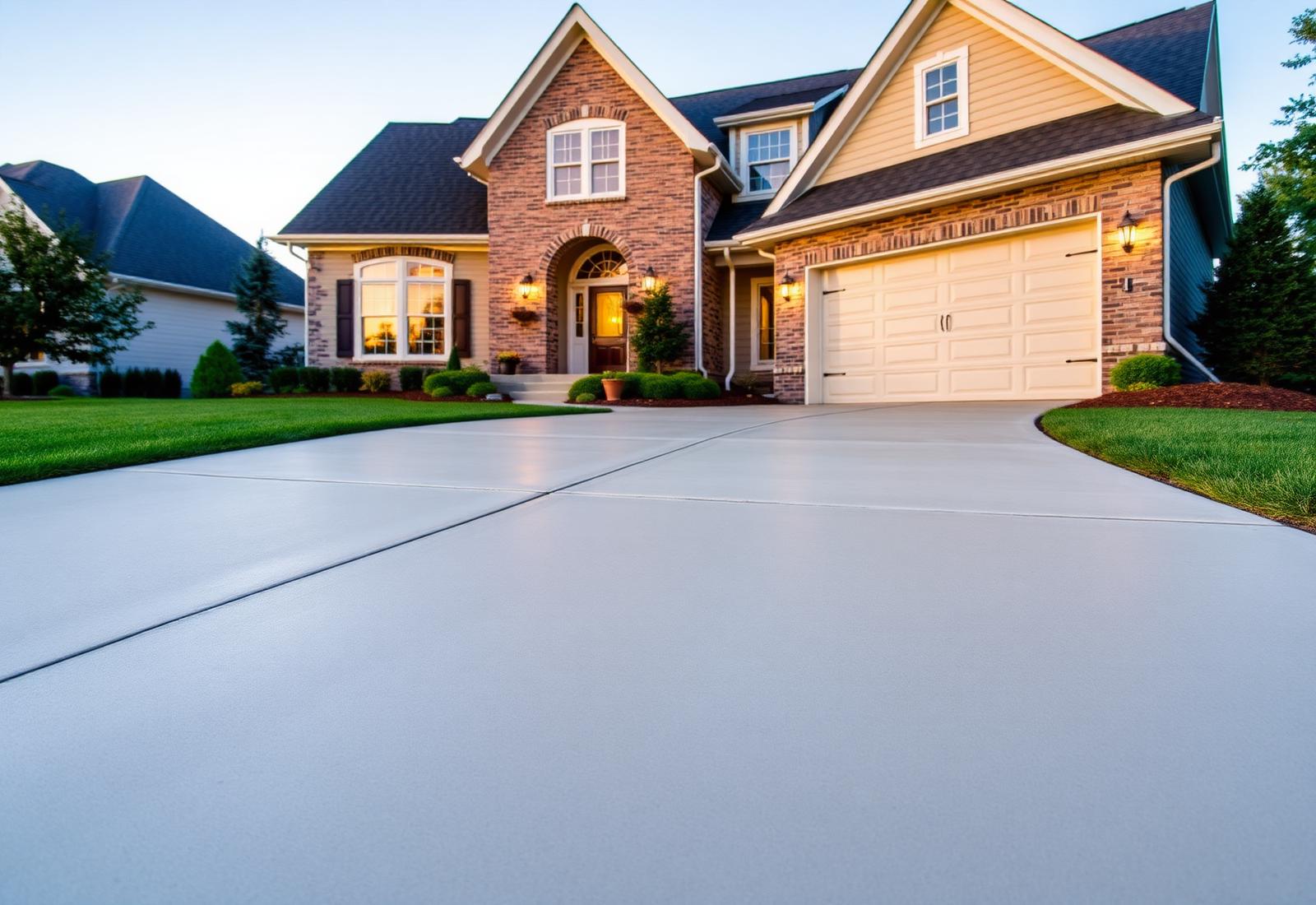
What the Ground Under a Springfield Driveway Is Doing
Most of Sangamon County is mapped to soils formed in loess — Virden and Ipava silt loams are the common ones — described by the USDA as poorly to somewhat poorly drained with moderately slow permeability. In plain terms: water does not leave quickly, and the clay fraction expands when it arrives. A driveway poured straight onto that ground without a compacted granular base is sitting on something that changes volume with the weather. That is the single most common reason older Springfield drives develop long, wandering cracks rather than tidy ones at the joints.
Base Over Bare Subgrade
A compacted aggregate base separates the slab from soil that shrinks and swells, and gives trapped water somewhere to drain sideways.
Level Ground Is Not Drained Ground
Slopes across much of the Springfield area run 0 to 2 percent. Flat looks easy, but it means runoff has to be given a deliberate path.
Backfill Near the Foundation
The strip of driveway nearest the garage is often over disturbed backfill, which settles differently than undisturbed ground.
Freeze-Thaw, Road Salt, and Springfield Winters
Springfield picks up around 36 inches of precipitation a year and swings across freezing repeatedly from late November into March. Each cycle expands the water held in the top of the slab. Exterior concrete here should be air entrained — those microscopic voids give freezing water room to go — and the surface should not be over-finished, because a dense, sealed-off top layer is the one that scales first. Add the salt that comes off city streets on tires every winter and the case for a properly cured, air-entrained, sealed driveway gets stronger.
Air Entrainment
Standard practice for exterior flatwork in central Illinois, and the main defense against surface scaling.
Pour Windows
Late spring through early fall gives the most forgiving curing conditions; cold-weather pours need protection and a longer schedule.
De-icer Exposure
First-winter concrete is the most vulnerable. Sand instead of salt through the first season is worth the inconvenience.
Driveways Differ by Springfield Neighborhood
The same 600 square feet is not the same job across town.
Historic West Side and Enos Park
Narrow drives between close-set older homes, occasional alley access, and limited room to stage a truck or spoils pile.
Leland Grove
Mature canopy trees mean root conflicts at the edges and shade that slows curing on the north side of a house.
Chatham and Sherman Subdivisions
Newer builds on former farmland: open access, but often engineered fill and young grades that are still settling.
Rochester and Riverton
Proximity to the Sangamon and its South Fork puts more weight on grading and where runoff is directed.
Getting to a Real Number
Square footage sets the floor on a driveway price. What moves it up or down is everything underneath and around it: how much of the old drive has to come out and get hauled, whether the subgrade needs undercutting and replacing with stone, thickness for the vehicles that actually park there, reinforcement, where control joints land relative to the garage apron, the approach to the city right-of-way, and how a ready-mix truck reaches the pour. Send photos of the existing drive and tell us where water stands after a hard rain — that one detail changes more estimates than anything else.
Request Your Driveways Estimate
Call Springfield IL Concrete or submit the estimate form to discuss your project.
Request a Concrete Estimate in Springfield
Call Springfield IL Concrete or submit the estimate form with your project details.